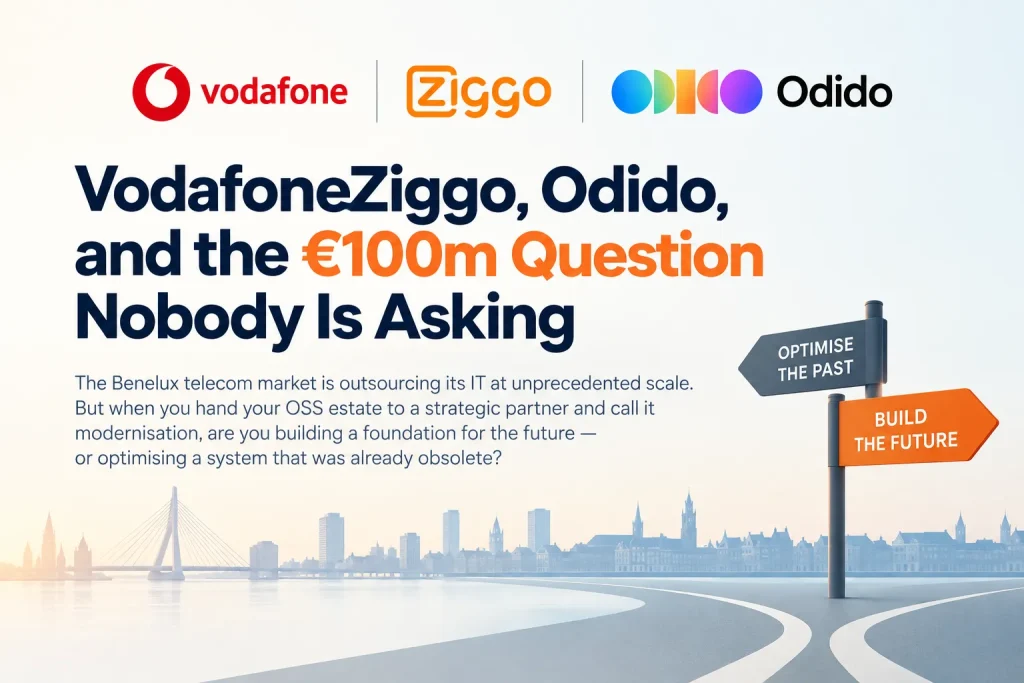

The Benelux telecom market is outsourcing its IT at unprecedented scale.
But when you hand your OSS estate to a strategic partner and call it modernisation, are you building a foundation for the future or optimising an already obsolete system?
Two deals closed in recent months that should be on every Benelux telecom executive’s radar.
VodafoneZiggo’s parent Liberty Global handed over its connectivity and entertainment platform operations to Infosys in a deal that reportedly delivers run-rate savings exceeding €100 million annually. And Odido, the Netherlands’ largest postpaid B2C mobile operator, signed a multi-year engagement with Wipro to modernise its entire IT landscape.
Both deals are framed the same way: AI-powered modernisation, productivity gains, cost reduction. Odido’s arrangement is particularly telling.
It uses what Wipro calls a “self-funded model”: productivity-driven savings are reinvested to fund new digital initiatives. The logic sounds impeccable: cut waste, fund innovation, transform continuously.
But there’s a question nobody is asking loudly enough.
What exactly is being modernised?
The optimisation trap
Outsourcing your IT estate to a global service provider delivers real, measurable savings. Infosys cut VodafoneZiggo’s testing cycle from four hours to five minutes. SFR’s comparable outsourcing round targeted 20 to 30 percent cost reductions across its IT maintenance. These numbers are genuine.
They’re also operational efficiency gains on systems that were designed for a different era.
The distinction matters. Outsourcing a batch-based OSS estate to a partner whose mandate is cost reduction produces something predictable: a cheaper batch-based OSS estate.
The partner optimises within the constraints they inherit. They don’t re-architect the data layer. They don’t change the fundamental assumption that network performance data arrives every fifteen minutes, not every fifteen milliseconds.
That’s not a criticism of Infosys or Wipro. It’s a statement about what outsourcing contracts actually reward. A service provider is measured on the savings they deliver against the baseline they’re given. Changing the baseline is outside their scope and often outside their incentive.

The self-funded paradox
Odido’s self-funded model deserves particular scrutiny. The proposition is elegant. Productivity savings from IT modernisation are recycled into continuous digital innovation. Innovation pays for itself. Sustainable transformation.
But follow the logic. Where do the savings come from?
They come from simplified operations, automation, and consolidated IT functions. That’s real value. But those savings are then reinvested into what?
Wipro’s WEGA and WINGS AI delivery platforms. Wipro’s conversational AI. Wipro’s design studio, Designit.
The self-funded model works beautifully as a commercial mechanism. But it doesn’t address the foundational question: is the data architecture underneath those AI initiatives actually capable of supporting them?
AI doesn’t need more data. It needs accurate, contextual, real-time data that reflects how the business actually operates. An AIOps platform trained on batch telemetry will produce batch-quality insights just faster and cheaper.
The OSS fault line
Here’s the technical reality that boardroom discussions often miss. Traditional OSS architectures were designed for a world of synchronous APIs and periodic batch processing. They enabled reliable 1:1 application communication and transactional integrity. That was the right design for that era.
But AI-driven operations require something different: large volumes of contextual data, available in real time, consumable by multiple systems simultaneously. A customer action in the BSS domain, a service modification in order management, and a configuration change in the network are treated as separate events across different systems.
In reality, they’re part of the same lifecycle.
Outsourcing the maintenance of a batch architecture locks in the wrong foundation and makes it harder to change later, because the partner’s incentives are tied to the savings they promised.
Why the public market changes everything
For Ziggo Group, preparing for a 2027 listing on the Amsterdam exchange, this isn’t an abstract architectural debate. It’s a valuation question.
Public equity markets in 2024 and 2025 have fundamentally recalibrated how they assess telecom and infrastructure IPOs. Investors no longer treat these listings as automatic infrastructure endorsements. They treat them as capital endurance tests.
The underwriting question is not whether demand exists, but whether the platform can fund maintenance, growth, and operational costs without repeated reliance on equity markets.
When Jio Platforms filed its DRHP, the risks it disclosed were instructive: network reliability, technology obsolescence, cybersecurity, and the need for continuous investment in network upgrades. These are the things public investors scrutinise.
And all of them are downstream of one foundational capability: real-time operational visibility.
A public company cannot afford to discover network issues when customers complain. It cannot report on service quality using data that’s hours old. It cannot run AI-driven operations on infrastructure designed for batch processing.
Investor scrutiny demands demonstrable operational efficiency, service reliability, and transparency, and batch-based OSS data cannot deliver any of those at the standard a public market expects.
Cost savings are a floor, not a ceiling
Let’s be clear about what these outsourcing deals achieve. They genuinely reduce IT operating costs. They consolidate vendor landscapes. They bring in AI capabilities that a single operator might struggle to build internally. For Odido, competing against KPN and VodafoneZiggo, that efficiency matters.
But efficiency is a floor, not a ceiling. It gets you to a competitive baseline. It doesn’t get you to differentiation.
The operators that will win the next decade are not the ones with the cheapest IT operations. They’re the ones with the most responsive operations the ones that can detect a network degradation before it becomes an outage, provision a service in seconds rather than hours, and feed AI models with data that reflects reality as it happens, not as it was fifteen minutes ago.
That capability doesn’t come from outsourcing a batch estate to a strategic partner. It comes from an architectural decision that outsourcing contracts typically don’t cover: moving from batch-based data to real-time streaming telemetry.
The €100m question
When VodafoneZiggo hands €100 million in annual savings to its shareholders, and Odido recycles productivity gains into AI-powered self-service, the question isn’t whether these deals are good. They are, on their own terms.
The question is: what happens to the OSS foundation underneath?
If that foundation remains batch-based, polling every fifteen minutes, reconciling data after the fact, feeding AI models a distorted view of reality, then the savings are real, but the transformation is incomplete. The operator has optimised the past rather than building for the future.
Cost savings are a floor. Real-time data is the ceiling. The operators that understand the difference will be the ones still standing when the market re-rates telecom not on what they saved, but on what they can actually do.
Evoura advises telecom operators on OSS modernisation, network automation, and the transition from batch-based data to real-time streaming telemetry. Independent. Vendor-neutral. No software.