
Telecom networks today generate unprecedented volumes of real-time telemetry data. Across access networks, transport layers, IoT devices, and enterprise services, millions of data points are produced every second, ranging from performance metrics and device signals to latency indicators and service health insights.
Despite this abundance, telecom network failures remain a persistent issue.
The problem is no longer visibility. Telecom operators can see what is happening across their networks. The real challenge, and the reason many outages and service disruptions still occur, is their inability to act on that data in real time.
The illusion of being data-driven
Over the past decade, telecom organizations have invested heavily in monitoring tools, OSS platforms, data lakes, and analytics environments. Streaming telemetry is widely available from routers, switches, mobile infrastructure, and IoT ecosystems.
On the surface, this creates the impression of a data-driven operation.
But in reality, much of this data is:
- Stored in silos rather than shared across systems
- Visualized in dashboards but not operationalized
- Fragmented across multiple vendors and platforms
This leads to a critical disconnect. Operators have access to insights, but not the ability to act on them when it matters most.
And that gap is one of the leading contributors to telecom network failure today.
The core problem: Telemetry without action

Most telecom environments still operate on a reactive workflow:
Telemetry → Dashboard → Manual action
While this model worked in the past, it is no longer sufficient for modern, high-scale networks.
The consequences are significant:
- Delayed incident response
- Manual, time-consuming troubleshooting
- Limited cross-domain visibility
- Increased risk of service disruption
In large-scale environments, even a few-minute delay can affect thousands of customers, violate SLAs, and disrupt connected systems. The issue isn’t a lack of data. It’s the inability to convert data into immediate, automated decisions.
Why most telecom networks fail to act on real-time data
So why does this gap persist?
The answer lies in a combination of technical and organizational challenges that prevent telecom operators from fully leveraging real-time data.
1. Fragmented system landscapes
Telecom environments comprise multiple systems that manage access networks, transport infrastructure, IoT platforms, and service assurance. These systems often operate independently, making real-time coordination difficult.
2. Data silos across the organization
Critical data is spread across OSS/BSS platforms, CRM systems, network logs, and IoT data streams. Without integration, forming a unified operational view becomes nearly impossible.
3. Data quality and trust issues
Inconsistent data formats, missing values, and conflicting KPIs reduce confidence in analytics. Poor data quality can lead to incorrect decisions or delayed action, increasing the risk of failure.
4. Legacy architectures
Many telecom systems were not designed for real-time processing. Batch-based workflows, polling mechanisms, and delayed pipelines prevent organizations from responding at the speed of their data demands.
5. Lack of event-driven thinking
Traditional architectures focus on collecting and analyzing data after the fact. In contrast, real-time environments require systems that react instantly to events as they occur.
6. The dashboard trap
Dashboards create visibility, but not action. Many operators rely heavily on visualization tools, assuming that insight alone will drive better outcomes. In reality, dashboards often introduce delays by requiring manual interpretation and response.
This is ultimately why most telecom networks fail to act on real-time data, not because the data is unavailable, but because the systems and processes are not built for real-time execution.
Hidden causes of telecom network failure
While outages are often attributed to hardware issues or network overload, the root causes of telecom network failure are increasingly tied to data and operations.
One major issue is data fragmentation. When critical insights are scattered across systems, operators lack the full context needed to identify and resolve problems quickly.
Another factor is manual data analysis at scale. Telecom networks generate terabytes of data daily, making it impossible to rely on manual queries or traditional analysis methods.
There is also a growing gap between AI potential and implementation. While machine learning models can detect anomalies and predict failures, their effectiveness depends on real-time, high-quality data. Without it, even advanced analytics remain reactive rather than proactive.
Together, these challenges create an environment where issues are detected too late or not acted on at all.
The missing link: From data to action
To overcome these challenges, telecom operators must shift from passive data consumption to active, real-time decision-making.
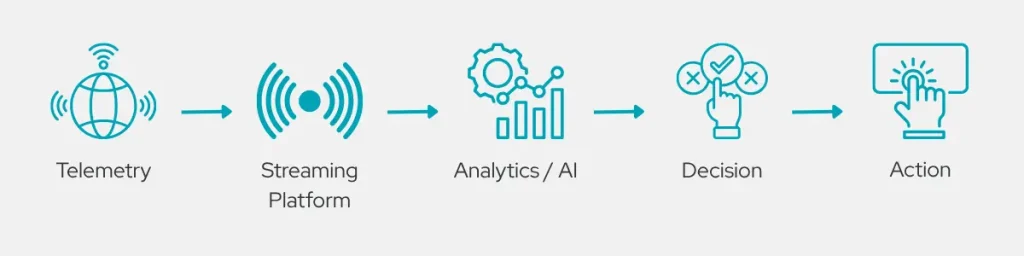
A modern operational model looks more like this:
Telemetry → Streaming Platform → Analytics / AI → Decision → Action
In this model, data is not just collected; it is continuously processed, analyzed, and acted upon in real time.
This enables:
- Immediate anomaly detection
- Automated incident response
- Real-time root cause analysis
- Continuous network optimization
Instead of waiting for engineers to interpret dashboards, systems can trigger actions automatically, reducing response times from minutes to milliseconds.
Building event-driven telecom networks
At the heart of this transformation is the move toward event-driven architecture.
Unlike traditional systems, event-driven models process data as it is generated. Technologies such as streaming platforms enable telecom operators to react instantly to changes in network conditions.
In practice, this means:
- Detecting anomalies the moment they occur
- Triggering automated workflows for remediation
- Enabling cross-domain visibility across networks and services
This shift not only improves operational efficiency but also significantly reduces the likelihood of telecom network failure.
Why this matters for IoT and industrial systems
The need for real-time action becomes even more critical in IoT and industrial environments.
These ecosystems rely on continuous connectivity and instant responsiveness. Delays in acting on telemetry can lead to:
- Production downtime
- Safety risks
- Supply chain disruptions
- Financial losses
As industries become more automated and interconnected, telecom networks must evolve into real-time operational platforms capable of supporting mission-critical applications.
The role of data governance
Technology alone is not enough to solve this challenge.
Without strong data governance, real-time data can quickly become overwhelming and unreliable. To support automation and decision-making, telecom operators must ensure:
- Standardized data models across systems
- Clear ownership and accountability
- Consistent KPI definitions
- Trusted, validated data streams
Data governance provides the foundation for turning real-time data into reliable, actionable insight.
From reactive to predictive: The future of telecom
Telecom operators are now moving toward a new model, one that is event-driven, automated, and intelligent.
In this model:
- Data is processed in real time
- Systems respond automatically
- AI enables predictive decision-making
- Operations shift from reactive to proactive
Real-time data platforms become the backbone of modern telecom networks, enabling faster decisions, improved resilience, and scalable automation.
Final thoughts
Telecom network failure is no longer caused by a lack of data. It is caused by the inability to act on it in real time.
As networks grow more complex and interconnected, the gap between telemetry and action becomes a critical risk. Operators that continue to rely on delayed insights and manual intervention will struggle to keep up with the demands of modern infrastructure.
The future belongs to organizations that can turn real-time data into immediate action.
Those that succeed will not only reduce downtime and improve performance but will also unlock new levels of operational intelligence and competitive advantage.
At Evoura, we help telecom and digital infrastructure organizations bridge this gap; designing real-time, event-driven architectures that transform data into action when it matters most.